7 Jordan Tetzlaff
This was my first year with Waterloo Men’s Hockey. Prior to joining I had been regularly attending UWAGGS meetings and gave a short show- and-tell on my hockey-related project. After that meeting, David and Arun asked me: “Do you like hockey?”. I was apprehensive at first because I was inexperienced at data science and software design. Throughout the term I was learned more and more through attending data solutions and IST meetings and by the end I was able to make a few contributions that I’m proud of.
Projects
Faceoff tracking
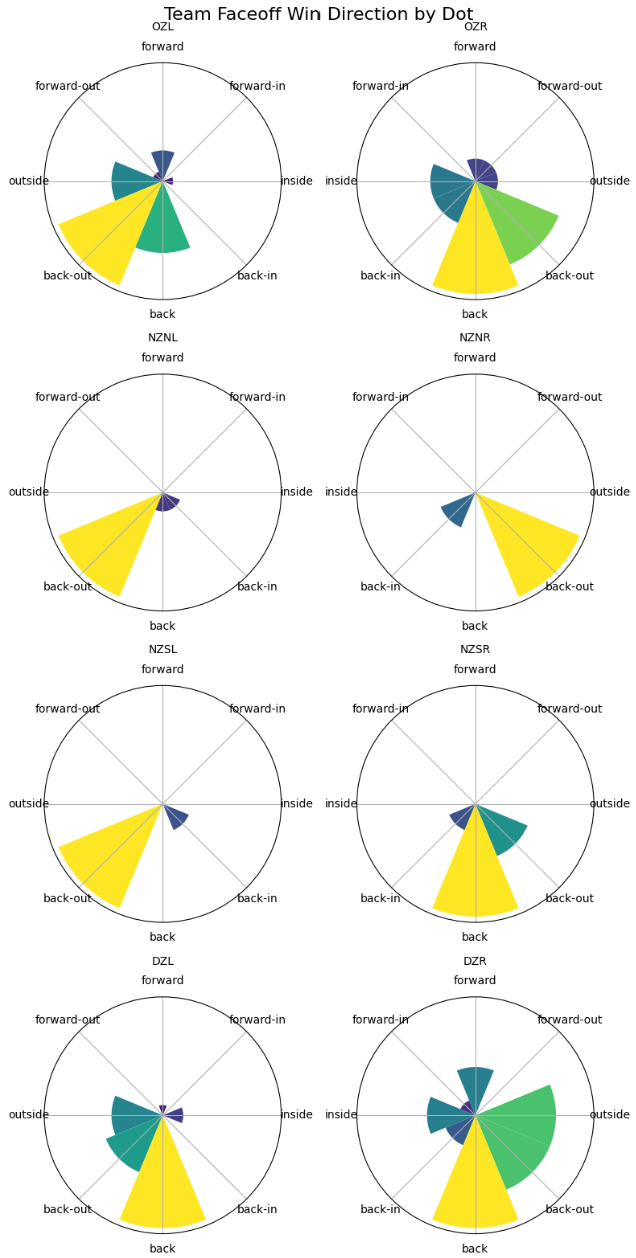
My first project spawned from a curiosity about our team’s effectiveness in the faceoff dot. Faceoffs are an important part of the game because they determine posession. Wins are also not the only important part, but the quality of the win as well. My data came from handtracking (something I have learned not to do since), which was painstaking but accurate. I tracked the data on players, faceoff locations, wins, win directions, and “clean-ness” of the win. After compiling a dozen games’ worth of data, I was able to create some visualizations which I thought were pretty cool, so I showed them to the coach. After a few more games it became clear to me that handtracking took too much time, so I chose to leave the project as it was. Some positive things that came from it: ideas and structure to use for a future, refurbished project, and a lesson to favour already existing data.
When to Pull Your Goalie
This was a project I collaborated on with Arun, with him really expanding on and polishing up the initial framework I laid. The question to answer was “When should I pull my goalie if I am X goals down and there are Y minutes left?”. My approach to this problem was Markov-like, taking into account all the states the game could be in by the third period, goals- and time- wise. Calculate the probability of winning for each state by taking into account probabilities of your team scoring and the other team scoring. At a certain point in the game it becomes beneficial to pull the goalie because the chances of winning increases more than the chances of losing decrease. To find these probabilities we used Usports data about situations where teams pulled their goalies to find out how often goals would happen, and this would come from the play- by-play database. I really have to thank Arun here for his help in organizing that database so that, in the end, we could arrive at 3 minutes for -1 goal and 6 minutes for -2. This was promptly communicated to the coach with an explanantion behind it.
Practice Organizer Tool
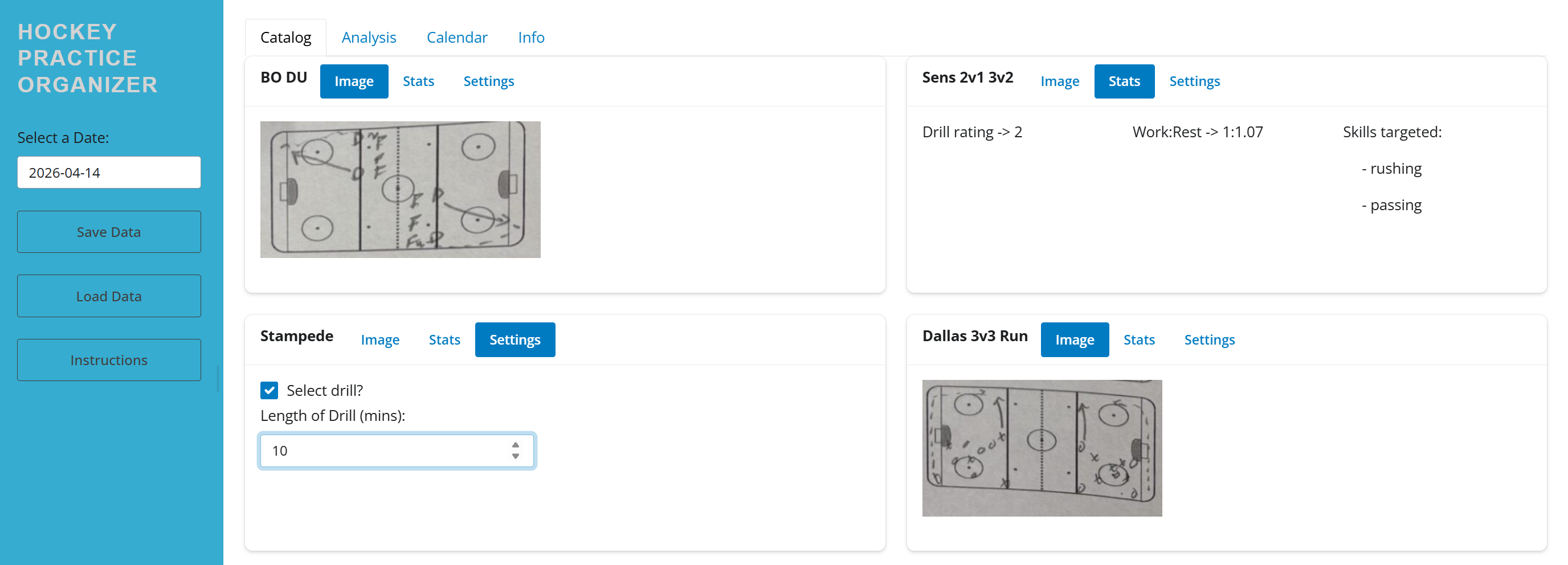
This was my biggest project and the one with the most involvement with my IST teammates. For our KIN472 final project we chose to work on practice loads and intensities on athletes. We aimed to figure out how intense certain drills and practices were and to find a good way to balance hard work and rest. For my contribution, I would make an app that would serve as the “application” of our concepts. The app would be a practice organizer, helping coaches choose drills and plan and organize practices with the idea of load in mind. To design the website I needed input from my IST teammates on how load should be measured, and with ideas coming from our team’s athletic trainer, Andrew Hopf. To build the website, I used Shiny for Python, which helped with its interactivity and data-focused nature. When the app and the rest of the project were done, we presented our work to the coaches with suggestions on how to keep practice load in mind.
Reflection
This experience has been a huge step-up for me, personally. I came in with little professional or technical experience but with a lot of interest in both the sport of hockey and in how data science can improve the performance and satisfactions for sports teams. I enjoyed being part of a group and hearing the perspectives of others, whether they were more experienced in data science than I am, or whether they were in a completely different field like kinesiology. The environment I was in really set me up to grow. Going to the games was good fun as well. If I were to do it again, I would spend more time with the athletes and coaches in the training environment. I would also try to have a bigger output. I faced many technical challenges early on that discouraged me from moving forward, but had I kept going and worked through it, it would be much more rewarding. Still, I managed to push through by the end and create the Practice Organizer, something I worked hard on and am proud of. Now, I am more motivated than ever to continue to work.